A car heads-up display can put speed, navigation-related data, and driving alerts in your line of sight without requiring you to look down at the dashboard. The best models balance readable screens, reliable data, and straightforward installation.
This roundup compares 10 HUD options, including GPS-powered units and OBD2 displays, so you can choose the right fit for your vehicle, driving habits, and budget.
Best 10 Car Heads Up Display Picks for 2026
Large-Screen Safety Monitor

- Large display shows speed, time, direction, and trip details
- Overspeed and fatigue-driving alerts
- Automatic brightness adjustment
Best For: Drivers wanting a large universal GPS speed display
Dual-Mode Data Gauge
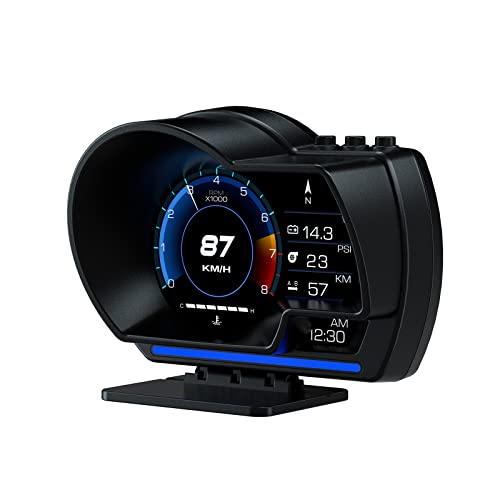
- OBD2 and GPS modes in one display
- Shows speed, RPM, voltage, fuel use, and temperature
- 10 interfaces with dashboard or windshield mounting
Best For: Drivers wanting broader vehicle data and GPS compatibility
Solar-Powered Travel Display

- Solar and USB power options
- Shows speed, time, temperature, and altitude
- Customizable overspeed and fatigue reminders
Best For: Drivers wanting a simple GPS HUD with flexible power
Advanced Performance Monitor

- OBD2 and GPS data fusion
- 13 themes with gesture control
- Performance testing and multiple vehicle alerts
Best For: Performance-focused drivers wanting detailed telemetry
Feature-Rich OBD HUD
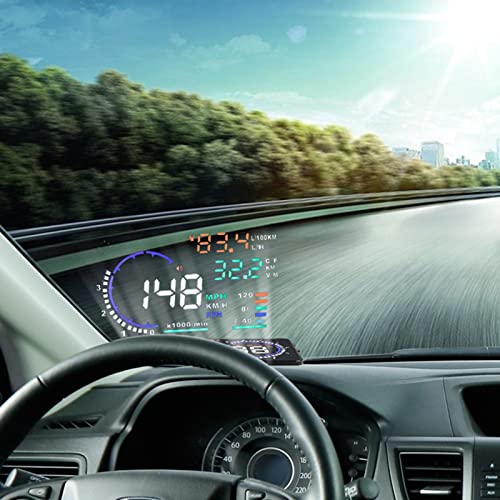
- Shows speed plus engine and vehicle information
- Includes multiple driving and vehicle alerts
- Automatic and manual brightness adjustment
Best For: Compatible OBDII/EUOBD vehicles needing detailed data
Simple GPS Speed HUD

- GPS and BDS positioning with 10Hz refresh
- USB plug-and-play without an OBD port
- Large font with automatic brightness
Best For: Vehicles needing a simple GPS speed display
OBD2 Windshield Projector
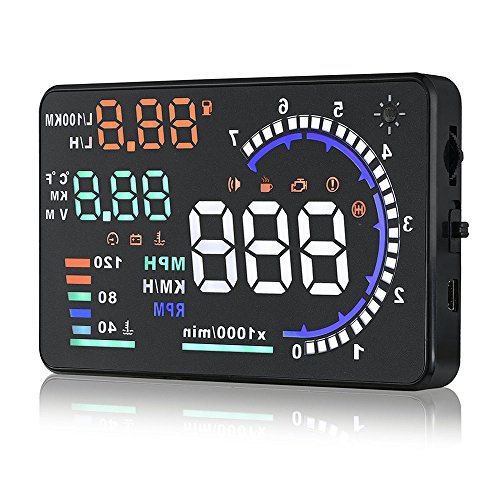
- Displays speed, RPM, temperature, voltage, and mileage
- Colorful screen with anti-ghosting film
- Automatic and manual brightness controls
Best For: Compatible gasoline vehicles needing OBD2 readings
Best GPS Value

- GPS+BDS reception with a 10 Hz refresh rate
- USB plug-and-play setup with MPH/KMH switching
- Adjustable brightness and customizable overspeed alert
Best For: Drivers wanting a simple GPS speed display without OBD2 installation
Best Windshield Projection

- Projects large speed data onto the windshield
- Shows RPM, temperature, voltage, trip, and fuel data
- Four alarm types with automatic brightness adjustment
Best For: Owners of compatible gasoline cars wanting a multi-data OBD2 HUD
Best Large-Screen Features

- Large 5.5-inch HD display with automatic brightness
- Shows speed, RPM, temperature, voltage, and fuel data
- Adds failure detection and code-clearing functions
Best For: Drivers wanting a large multi-function OBD2 vehicle display
Large-Screen Safety Monitor – SinoTrack 5.5-Inch GPS HUD
If you want a straightforward car heads up display focused on speed and trip information, the SinoTrack GPS HUD offers a large 5.5-inch screen. It shows MPH, driving time, mileage, time, direction, and satellite information, while GPS operation makes it suitable for vehicles without relying on an OBD2 connection.
Best For: Drivers who want a large, universal GPS speed display with overspeed and fatigue reminders.
Pros:
- Large screen displays speed and several driving details at once.
- Automatic brightness adjustment helps maintain visibility in changing light.
- Includes overspeed and four-hour fatigue-driving alerts.
- One-key operation makes settings and display changes simple.
Cons:
- It must use a 5V power supply and should not be connected to a higher voltage source.
- Trip distance does not accumulate or remain stored when the vehicle is powered off.
- It provides GPS-based information rather than OBD vehicle diagnostics.
The SinoTrack is a practical choice when clear speed visibility and basic safety reminders matter more than extensive vehicle data. Its large display is useful, but installation should follow the specified power requirements carefully.
Dual-Mode Data Gauge – wiiyii P6 OBD2 HUD
The wiiyii P6 is a versatile car heads up display for drivers who want more than speed. Its OBD2 and GPS modes can show speed, voltage, fuel consumption, RPM, water temperature, and other vehicle data, while the included mounting options support dashboard or windshield installation.
Best For: Drivers seeking a compact OBD2 display with GPS fallback and multiple vehicle readouts.
Pros:
- Combines OBD2 data with GPS speed information.
- Offers 10 switchable interfaces and can read more than 100 OBD data types.
- Displays overspeed alerts and changes ambient lighting from blue to red for abnormal conditions.
- Includes both a rotary suction-cup bracket and 3M tape for installation flexibility.
Cons:
- OBD features depend on vehicle compatibility with the OBD2 protocol.
- Vehicles without compatible OBD2 support receive GPS functionality only.
- Its data-rich interface may be more than needed for drivers who only want speed.
Choose the P6 if vehicle information and flexible installation are priorities. The dual-mode design expands compatibility, but buyers should confirm their vehicle supports the desired OBD2 functions.
Solar-Powered Travel Display – Wireless GPS Solar HUD
This wireless car heads up display is designed for drivers who prefer a self-contained GPS speedometer. It shows speed, time, temperature, and altitude on a high-contrast LCD, with solar charging and USB power options for flexible everyday use.
Best For: Drivers who want a simple GPS display with solar charging and adjustable safety alerts.
Pros:
- Supports both solar charging and USB power.
- Displays speed, time, temperature, and altitude in large digital figures.
- Automatic brightness recognition helps the screen remain visible in day or night conditions.
- Offers customizable overspeed and fatigue-driving reminders.
Cons:
- It focuses on GPS display functions rather than OBD vehicle diagnostics.
- Solar charging performance depends on available light.
- The supplied notes do not specify included mounting accessories or installation details.
The solar-powered design makes this model appealing for drivers who want fewer wiring concerns. It is best viewed as a focused GPS information display with useful alerts, rather than a comprehensive vehicle monitor.
Advanced Performance Monitor – wiiyii P28 OBD2 HUD
The wiiyii P28 is an advanced car heads up display for drivers who want detailed vehicle monitoring and performance features. Its OBD2 and GPS systems can show data such as speed, RPM, water temperature, voltage, fuel consumption, turbo pressure, altitude, and compass information, with gesture control for changing interfaces.
Best For: Performance-minded drivers who want extensive vehicle data, alerts, and testing functions.
Pros:
- Combines OBD2 and GPS data for broad vehicle compatibility and detailed monitoring.
- Offers 13 themes, gesture control, and a 3.6-inch high-definition display.
- Includes speed, temperature, voltage, and fatigue-driving alerts.
- Adds acceleration, braking, turbo-pressure, and dynamic-curve functions for performance reference.
Cons:
- OBD data availability depends on the vehicle and its compatibility.
- The extensive features may be excessive for drivers seeking only a basic speed display.
- The supplied dimensions are incomplete, so the exact overall size cannot be confirmed from the notes.
The P28 is the most feature-heavy option in this group, especially for users interested in vehicle telemetry and performance testing. Its gesture control and adjustable bracket add convenience, while the number of functions may require more setup than a basic HUD.
Feature-Rich OBD HUD – 5.5-Inch Multi-Color Car HUD
This car heads up display is designed for drivers who want more vehicle information in view without looking down at the dashboard. Its OBDII/EUOBD connection provides speed and multiple engine-related readings, while adjustable brightness and a windshield-friendly display help improve readability.
Best For: Drivers with a compatible OBDII or EUOBD vehicle who want speed, engine data, alerts, and diagnostic information in one display.
Pros:
- Displays speed, RPM, water temperature, battery voltage, fuel-consumption data, mileage, and fault codes.
- Offers manual brightness adjustment plus automatic brightness optimization.
- Includes overspeed, high-temperature, low-voltage, shift, and fatigue-driving reminders.
- Automatically powers on and off with the vehicle.
Cons:
- Requires an OBDII/EUOBD-compatible vehicle.
- The broad selection of readings may be more than some drivers need.
This is a versatile choice if you want a car HUD that goes beyond basic speed projection. Confirm vehicle compatibility before ordering, especially if you mainly want a simple, GPS-based display.
Simple GPS Speed HUD – USB Car Heads Up Display
This car heads up display uses GPS and BDS satellite positioning to project speed without requiring an OBD port. Its USB plug-and-play setup, large font, and automatic brightness adjustment make it a practical option for drivers seeking a straightforward speed display.
Best For: Drivers of cars, trucks, or motorcycles with a USB port who want a simple GPS speedometer without OBD compatibility concerns.
Pros:
- Uses dual-mode GPS and BDS positioning with a 10Hz refresh rate.
- USB-powered and compatible with most vehicles equipped with a USB port.
- Large, anti-reflective display supports clear daytime and nighttime viewing.
- Automatically adjusts brightness using an integrated light sensor.
Cons:
- GPS speed can differ by approximately 0.6–1.8 MPH.
- Signal may be affected in tunnels, garages, severe weather, or behind metallic windshield film.
- Its listed function centers on speed rather than broader vehicle diagnostics.
This model is a good fit when easy installation and broad vehicle compatibility matter more than OBD-based engine readings. Expect the best accuracy in open areas with a clear satellite signal.
OBD2 Windshield Projector – A8 5.5-Inch Car HUD
This car heads up display connects to compatible OBD II or EUOBD gasoline vehicles and projects several driving metrics onto the windshield. It combines plug-and-play installation with speed, RPM, temperature, voltage, and fuel-consumption information for drivers who want more than a standalone speedometer.
Best For: Owners of compatible gasoline vehicles who want a colorful OBD2 display with speed monitoring and basic vehicle readings.
Pros:
- Displays speed, RPM, water temperature, voltage, and single mileage.
- Uses a 5.5-inch colorful display with anti-ghosting reflective film.
- Supports automatic and manual brightness adjustment.
- Includes an overspeed warning and ignition-linked automatic power control.
Cons:
- Not compatible with Dodge, Jeep, Mazda, Suzuki, French or Italian vehicles, and some Hyundai/Kia models.
- Designed for OBD II/EUOBD gasoline vehicles, so compatibility should be checked before purchase.
- Does not offer the GPS-based installation flexibility of a USB speed display.
This A8 HUD is worth considering if your vehicle is on the compatible list and you want engine-related information alongside speed. The main buying consideration is compatibility, so verify the vehicle before ordering.
Best GPS Value – Compact Car HUD Speedometer
This compact car heads up display is a practical choice for drivers who want a clear GPS-based speed readout without connecting to the vehicle’s diagnostic port. Its dual-mode GPS+BDS chip, 10 Hz refresh rate, adjustable brightness, and USB plug-and-play setup make it easy to add to many vehicles.
Best For: Drivers seeking a simple, portable GPS speedometer with overspeed alerts and MPH/KMH switching.
Pros:
- Uses GPS+BDS reception and can track up to 32 satellite signals for stable speed data.
- USB-powered plug-and-play installation avoids complicated wiring.
- Offers speed calibration, adjustable brightness, and a customizable overspeed alert.
- Compact display with large numerals and anti-reflective shading.
Cons:
- GPS performance may be affected in tunnels, underground garages, heavy rain, fog, or behind metallic windshield film.
- Displays speed and related HUD information rather than the broader vehicle data available from an OBD2 device.
Choose this model when uncomplicated installation and GPS-based speed monitoring matter most. Its compact design and flexible display settings are especially useful for drivers who do not need diagnostic or engine readings.
Best Windshield Projection – MAIMEIMI OBD2 HUD
The MAIMEIMI car heads up display projects driving information onto the windshield, helping keep speed and vehicle data in view. It connects through an OBD2/EUOBD interface and adds readings such as RPM, water temperature, voltage, trip information, and fuel consumption.
Best For: Drivers with compatible gasoline vehicles who want windshield projection and multiple real-time vehicle readings.
Pros:
- Projects large-font speed information directly onto the windshield.
- Displays speed, RPM, trip, water temperature, voltage, and fuel-consumption data.
- Includes overspeed, fatigue-driving, speed, and engine-failure alarms.
- Automatic brightness adjustment with manual brightness control also available.
Cons:
- Compatibility is limited to supported OBDII/EOBD gasoline vehicles, generally made after 2008.
- It does not support OBDI or JOBD and excludes several listed brands, hybrids, diesel vehicles, pickups, RVs, and vehicles with modified ECUs.
- Requires manual speed fine-tuning if the displayed speed differs from the vehicle’s reading.
This is a stronger fit than a basic GPS HUD for shoppers who want deeper vehicle data and windshield projection. Carefully verify the vehicle’s protocol and the manufacturer’s compatibility exclusions before buying.
Best Large-Screen Features – 5.5-Inch OBD2 Car HUD
This large-screen car heads up display combines a 5.5-inch HD display with OBD2 vehicle monitoring. It can show speed, RPM, water temperature, voltage, and fuel consumption, while also offering automatic brightness adjustment, warning prompts, and selected diagnostic functions.
Best For: Drivers who prioritize a large display and want speed, vehicle gauges, and basic OBD2 diagnostic features in one accessory.
Pros:
- 5.5-inch HD screen is designed for clear real-time viewing.
- Displays GPS speed, RPM, water temperature, voltage, and fuel consumption.
- Includes speeding and voltage anomaly alerts.
- OBD2 functions include failure detection, failure alarms, and failure-code clearing.
Cons:
- Requires a vehicle using an OBD2 or EOBD protocol.
- The supplied notes do not specify detailed exclusions for individual makes or models, so compatibility should be confirmed before purchase.
- Its larger enclosure may be less discreet than a compact GPS-only display.
Consider this model if you want more than a speed readout and prefer a larger viewing area. Its combination of gauge information and diagnostic functions gives it broader utility, provided the vehicle supports the required OBD2/EOBD connection.
How We Picked the Best Car Heads Up Display
We focused on the features that matter most in everyday driving: display readability, data accuracy, installation method, compatibility, alert options, and overall usefulness. The selection includes both GPS units, which generally work across a wide range of vehicles, and OBD2 models that can show vehicle data such as RPM, coolant temperature, fuel consumption, or fault information when supported.
We also considered screen size, day-and-night visibility, speed-unit options, mounting flexibility, and whether a model is better suited to occasional use or permanent installation. Because product specifications can vary by seller and vehicle, confirm the included cable, supported interface, and regional speed units before ordering.
Quick Comparison
| Type | Best For | Main Advantage | Potential Limitation |
|---|---|---|---|
| GPS HUD | Broad vehicle compatibility | Usually installs without vehicle diagnostics | May offer fewer engine readings |
| OBD2 HUD | Vehicle-data enthusiasts | Can display RPM, temperature, and other metrics | Compatibility varies by vehicle |
| Large-screen HUD | Fast-glance readability | Prominent speed and warning display | Can occupy more dashboard or windshield space |
| Solar or wireless-style HUD | Reduced cable clutter | Convenient placement and portability | Power and charging behavior require attention |
Key Buying Factors for a Car Heads-Up Display
GPS or OBD2 Connection
Choose GPS if you want simple, vehicle-independent speed tracking. Select OBD2 if you want richer engine information and your car has a compatible diagnostic port. OBD2 displays may not support every vehicle or every advertised reading, especially on older, hybrid, or region-specific models.
Screen Clarity and Projection Position
A bright, high-contrast screen is easier to read in changing light. Look for adjustable brightness, color options, and a windshield reflector or screen designed to reduce glare. The unit should sit where it is visible without blocking important road or instrument-panel views.
Warnings and Displayed Data
Overspeed alerts are useful when configured correctly, while fatigue reminders can provide an additional prompt on long drives. Decide whether you primarily need speed, or also want altitude, time, RPM, coolant temperature, fuel data, and other readings. More data is not always better if it makes the display distracting.
Installation and Power
Check whether the HUD uses a USB cable, 12-volt adapter, OBD2 plug, or internal battery. Cable routing should be secure and clear of pedals, steering controls, and airbags. Follow local laws regarding windshield-mounted accessories and avoid placing the display in the driver’s critical field of vision.
Who Should Buy Which Car Heads Up Display?
Choose a GPS model if you want the easiest setup or drive multiple vehicles. Choose an OBD2 model if your vehicle is compatible and you want engine readings beyond speed. Choose a large 5.5-inch display if quick readability is your top priority. Choose a compact or wireless-style unit if you prefer a less cluttered dashboard or need something easy to move between cars.
Before buying, verify MPH or KMH support, your vehicle’s OBD2 compatibility, the available mounting hardware, and the return policy. A well-positioned car heads-up display should improve glanceability—not compete with the road for your attention.