Finding reliable ramps for a low-clearance vehicle can make oil changes, inspections, and other garage tasks easier without relying on a floor jack alone. The right design should provide a gradual approach, stable tire placement, and enough capacity for your vehicle.
We’ve gathered 10 low-profile car ramps with different lift heights, materials, weight ratings, and portability features so you can match the ramp to your car, garage, and maintenance routine.
Best 10 Car Ramps for Low Cars Picks for 2026
Best Gentle-Approach Ramp

- 9.05° loading angle
- 2.5-inch lift
- 10,000-lb GVW pair capacity
Best For: Low-clearance cars needing modest service lift
Best Detachable Design
Megan Racing Low Profile Ramps
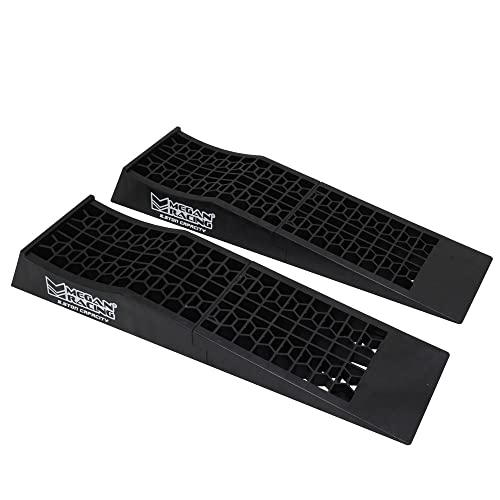
- Detaches into four pieces
- 2.56-inch lift
- High-strength plastic composite
Best For: Low-profile cars and compact ramp storage
Best Higher-Lift Option

- 6.25-inch lift
- 6,500-lb pair capacity
- Grooved surface and rubber base stops
Best For: Maintenance requiring extra underbody clearance
Best Stable Wide Ramp
Auto Dynasty Low-Profile Ramps

- 13-inch-wide ramp body
- 5,000-lb GVW capacity
- Anti-slip tread, base, and rubber blocks
Best For: Home-garage oil changes on tires up to 9 inches wide
Best Extendable Option
MaxxHaul 50709 Detachable Extendable Ramps

- 9.5° incline and 6-1/2-inch lift
- 6,500-pound matched-pair capacity
- Detachable sections and carrying handles
Best For: Flexible maintenance setups requiring extra lift and extendable length
Best Lightweight Low-Chassis Pick

- 2.6-inch lift for low-chassis vehicles
- 10-inch width for wider tires
- Only 5.3 pounds per pair
Best For: Portable garage maintenance on sports cars and other low vehicles
Best Routine-Maintenance Value
MaxxHaul 50516 Low Profile Ramps

- 9.05° loading angle for low-clearance cars
- 2.5-inch maximum lift height
- 4,400-pound matched-pair capacity
Best For: Basic underside maintenance with a compact, low-angle ramp
Best Heavy-Duty Option
ROBLO CK Low Profile Car Ramps

- 13,000-pound gross vehicle weight rating
- 12-inch width for wider tires
- Traction features and portable carry holes
Best For: Garage maintenance on cars, SUVs, and light trucks
Best Simple Garage Pick

- 6.7-inch lift for maintenance access
- 12,000-pound total capacity
- Anti-slip base and 17-degree incline
Best For: Routine oil changes on standard cars
Best Low-Lift Design
VEVOR Portable Car Service Ramps

- 2.56-inch listed lift for low chassis
- Four-piece, stackable polypropylene set
- Honeycomb and curved surfaces aid traction
Best For: Low vehicles needing modest lift and easy storage
Best Gentle-Approach Ramp – Black Widow Low Car Ramps
For drivers comparing car ramps for low cars, the Black Widow ramps offer a relatively gentle 9.05-degree loading angle and a 2.5-inch lift. Their compact profile is suited to oil changes and basic underbody access, provided your vehicle’s clearance and weight are within the stated limits.
Best For: Low-clearance cars needing a modest lift for oil changes and routine service.
Pros:
- Gentle 9.05-degree approach angle accommodates many vehicles.
- Honeycomb plastic construction is designed for strength and reduced moisture buildup.
- Pair supports up to 10,000 pounds total vehicle weight, or 5,000 pounds per axle.
- Compact 27.5-inch length and slight tire stop help with storage and positioning.
Cons:
- The 2.5-inch lift provides less working clearance than taller ramps.
- Vehicle clearance and gross weight must be confirmed before use.
- The supplied guidance recommends using a spotter to help prevent roll-offs.
This is a practical choice when approach angle matters more than maximum height. It keeps the lift low and manageable for routine maintenance, but it is not intended to provide the underbody clearance of a taller ramp.
Best Detachable Design – Megan Racing Low Profile Ramps
The Megan Racing ramps are a flexible option among car ramps for low cars, combining a low-profile drive-on design with detachable sections. They raise a vehicle 2.56 inches and are made from high-strength plastic composite for basic garage service and jack access.
Best For: Low-profile vehicles and users who value ramps that can separate into smaller pieces.
Pros:
- Low-profile design is intended for low-profile cars.
- Detaches into four pieces for potentially easier handling or storage.
- Provides a 2.56-inch lift for access beneath the vehicle.
- Rated at 5,000 pounds per side according to the supplied product information.
Cons:
- The lift remains relatively modest for work requiring substantial clearance.
- The supplied dimensions are 27.8 by 7.8 by 3.5 inches, so the driving surface is not especially wide.
- The notes do not specify additional base stabilizers or rubber stops.
The detachable construction distinguishes this pair from simpler fixed ramps. Consider it when storage and modular handling are priorities, while checking your tire width, vehicle weight, and available clearance before driving onto the ramps.
Best Higher-Lift Option – MaxxHaul 6.25-Inch Car Ramps
If your maintenance work needs more room underneath, the MaxxHaul 50515 provides a 6.25-inch lift. These heavy-duty plastic car ramps for low cars use a deep-grooved surface, rubber base stops, and a 6,500-pound pair capacity to support routine repair and maintenance tasks.
Best For: Vehicle maintenance that benefits from more underbody clearance and a traction-focused surface.
Pros:
- 6.25-inch maximum lift provides more workspace than low-rise alternatives.
- Rated for 3,250 pounds per ramp and 6,500 pounds per pair.
- Deep ridges add traction for tire placement.
- Rubber stops on the base help reduce movement or slipping.
Cons:
- The 35.5-inch length and 12-inch width make these bulkier to store.
- The taller ramp may require careful clearance checks on very low vehicles.
- The supplied manufacturer warranty is limited to 90 days.
This model is the strongest fit here for users prioritizing working height over compactness. For a low car, verify the approach and underside clearance before purchase, then stay within the per-ramp and pair weight ratings.
Best Stable Wide Ramp – Auto Dynasty Low-Profile Ramps
The Auto Dynasty ramps combine a 17-degree incline with a 5,000-pound gross vehicle weight rating and a 13-inch-wide body. For shoppers seeking car ramps for low cars, the design emphasizes tire grip and base stability while providing added clearance for oil changes and general repairs.
Best For: Home-garage maintenance on vehicles with tires up to 9 inches wide.
Pros:
- Non-skid tread pattern helps reduce tire slippage.
- Non-skid base, anti-slip grooves, and rubber blocks are designed to improve stability.
- Drainage design helps prevent water accumulation.
- Supports up to 5,000 pounds total, or 2,500 pounds per ramp.
Cons:
- The 17-degree incline may not suit every extremely low chassis.
- Capacity is lower than the Black Widow and MaxxHaul pair ratings.
- Use is specified for tires up to 9 inches wide, so wider tires require verification.
With its wider footprint and multiple anti-slip features, this pair is aimed at stable home-garage use. Confirm your tire width, vehicle weight, and approach clearance before relying on the ramps for service work.
Best Extendable Option – MaxxHaul 50709 Detachable Extendable Ramps
For car ramps for low cars that need more reach and flexibility, the MaxxHaul 50709 combines a 9.5° incline with a 6-1/2-inch lift height. Its detachable sections can help free space beneath the vehicle, while separately sold extensions can increase the ramp length for different setups.
Best For: Drivers who want portable, extendable ramps for maintenance on a hard, level surface.
Pros:
- Low 9.5° incline is suited to lower-clearance vehicles.
- 6,500-pound matched-pair capacity, with up to 3,250 pounds per ramp.
- Detachable design, carrying handles, and secure tab-and-notch connections.
Cons:
- Extensions are sold separately.
- Must not be used on uneven, sloped, slippery, or loose surfaces.
- At approximately 33 pounds per pair, it is heavier than the other options here.
The MaxxHaul 50709 stands out when you need more lift than a basic low-profile ramp and value a configurable setup. Confirm your vehicle and surface requirements before use, and never exceed the matched-pair rating.
Best Lightweight Low-Chassis Pick – HOXWELL Low Profile Car Ramps
The HOXWELL ramps are designed specifically for low-chassis cars, sports cars, and tuners. With a 17° slope and a 2.6-inch lift at the tire position, they provide a compact way to support routine inspections, repairs, and maintenance.
Best For: Low vehicles needing lightweight, easy-to-store ramps for garage work.
Pros:
- 10-inch width helps accommodate wider tires on modified cars.
- Honeycomb traction surface, curved profile, drainage design, and bottom non-slip pads support stability.
- Weighs only 5.3 pounds per pair for convenient carrying and storage.
Cons:
- Lift height is limited to 2.6 inches at the tire placement position.
- The listed 17° slope is steeper than the incline on the MaxxHaul 50709.
- The supplied notes do not specify a precise pound rating; they list a 20,000-pound GVW.
For shoppers prioritizing portability and a low-profile design, the HOXWELL is a practical choice. Its wider footprint and traction-focused construction are useful additions, but verify compatibility with your vehicle and the stated lifting position.
Best Routine-Maintenance Value – MaxxHaul 50516 Low Profile Ramps
MaxxHaul 50516 4,400 lb. Capacity Low Profile Car Ramps, 2-Count, Black (Pack of 1)
Check Price On AmazonThe MaxxHaul 50516 is a straightforward option for car ramps for low cars, using a 9.05° loading angle and a 2.5-inch maximum lift height. Its heavy-duty plastic construction and honeycomb channels are intended to support routine underside maintenance while helping shed dirt and moisture.
Best For: Owners who need simple low-angle ramps for routine vehicle maintenance.
Pros:
- 9.05° loading angle is designed for low-clearance vehicles.
- 4,400-pound pair capacity, rated at 2,200 pounds per ramp.
- Honeycomb channels help remove debris and reduce moisture buildup.
Cons:
- Maximum lift height is only 2.5 inches.
- At 7-3/4 inches wide, it is narrower than the HOXWELL option.
- The product details list a conflicting 4-pound load-capacity field, so rely on the stated 4,400-pound pair rating and verify requirements before use.
The 50516 is a sensible compact ramp for basic maintenance when a gentle approach angle matters. Its lift is modest, so it is best suited to tasks that do not require substantial clearance beneath the vehicle.
Best Heavy-Duty Option – ROBLOCK Low Profile Car Ramps
For shoppers comparing car ramps for low cars, the ROBLOCK pair combines a 6.1-inch lift with a 13,000-pound gross vehicle weight rating. Its 12-inch width, 17-degree approach, and traction-focused surface make it suited to garage oil changes and other maintenance tasks.
Best For: Home garages and service work involving cars, SUVs, pickups, and light trucks.
Pros:
- 13,000-pound gross vehicle weight rating.
- 12-inch width accommodates wider tires.
- Honeycomb construction, tire grooves, bumper strips, drainage, and bottom pads support stable positioning.
- Side and rear carry holes aid transport and storage.
Cons:
- Its 6.1-inch lift is lower than some alternatives.
- Plastic construction may not suit shoppers seeking steel ramps.
Choose this set when width, high rated capacity, and several traction features matter more than minimizing ramp height. The portable design also makes it practical for repeated garage use.
Best Simple Garage Pick – Garvee Plastic Service Ramps
These car ramps for low cars offer a straightforward setup for oil changes and routine maintenance. The plastic pair provides a 6.7-inch lift, 12,000-pound capacity, 17-degree incline, and anti-slip base for garage use.
Best For: Owners of standard cars with tires no wider than 9 inches who want portable maintenance ramps.
Pros:
- 6.7-inch lift creates useful underbody working clearance.
- 12,000-pound total vehicle capacity.
- 17-degree incline is designed for easier access by low-clearance vehicles.
- High-strength engineering plastic is portable and durable.
Cons:
- Designed for tires no wider than 9 inches.
- Offers fewer described tire-positioning features than some competing designs.
This is a practical choice when your tires fit the stated width limit and you want a simple, lightweight pair for regular home maintenance. Confirm tire width and vehicle weight before buying.
Best Low-Lift Design – VEVOR Portable Car Service Ramps
For especially low vehicles, the VEVOR car ramps use a 2.56-inch lift to reduce the initial height change. The four-piece polypropylene set is portable and stackable, with a honeycomb surface and curved tire-supporting design for maintenance and oil changes.
Best For: Low-chassis vehicles needing modest lift and a compact, stackable ramp setup.
Pros:
- 2.56-inch lift is suited to low-profile access.
- Four-piece configuration supports flexible handling and storage.
- Impact-resistant PP offers weather and corrosion resistance.
- Honeycomb, drainage, curved, and grooved surfaces help with traction and storage.
Cons:
- The supplied notes contain conflicting capacity figures, listing both 16,000-pound GVW and a 13,000- to 20,000-pound range.
- Its low 2.56-inch lift provides less working clearance than taller ramps.
- The listing description references both a 2.56-inch lift and a 6.7-inch incline design, so buyers should verify specifications.
This set stands out when approach height and portability are priorities. Because the supplied specifications conflict, verify the current listing’s capacity and lift details before relying on it for a particular vehicle.
How We Picked These Car Ramps for Low Cars
We focused on ramps designed to reduce clearance problems while still providing useful lift for common garage maintenance. The selection includes steel and plastic models, two-piece and four-piece sets, detachable or extendable designs, and ramps with capacities ranging from basic passenger-car use to heavy-duty applications.
We also considered practical details such as stated weight capacity, lift height, ramp width, tire traction, portability, and whether the ramp can be used alongside a jack or jack stands. Always confirm the manufacturer’s rating and use the ramps on a level, stable surface.
Quick Comparison
| Ramp type | Best suited for | What to check |
|---|---|---|
| Low-profile steel ramps | Regular oil changes and durable garage use | Approach angle, width, and corrosion resistance |
| Detachable or extendable ramps | Vehicles with especially limited clearance | Connection security and assembled length |
| Plastic ramps | Lightweight storage and occasional maintenance | Material rating, surface stability, and heat exposure |
| High-capacity ramps | Trucks, SUVs, and heavier vehicles | Gross vehicle weight compatibility and tire fit |
Key Buying Factors for Car Ramps for Low Cars
Approach Angle and Lift Height
A low approach angle matters more than maximum lift when a vehicle has a low front splitter or underbody. Ramps with a gradual incline or detachable extension are often easier to position without scraping. Choose the lift height based on the work you need to perform, since higher ramps are not automatically better.
Capacity and Actual Vehicle Weight
Do not compare ramp capacity with curb weight alone. Account for the vehicle’s gross weight and how that load is distributed across the supported tires. Leave a sensible safety margin, and never exceed the manufacturer’s stated rating. For trucks and SUVs, heavy-duty options may provide more appropriate capacity and width.
Traction, Width, and Tire Placement
Look for deep grooves, raised surfaces, wheel stops, or other features that help prevent tire movement. The ramp should be wide enough for your tires and positioned squarely before driving onto it. A narrow ramp can be difficult to use accurately, particularly in a cramped garage.
Storage and Maintenance
Steel ramps are generally durable but can be heavy and bulky. Plastic ramps are easier to carry, while detachable designs may store more conveniently. Check for cracks, bends, loose parts, or damaged traction surfaces before every use.
Who Should Buy Which Car Ramps for Low Cars?
For low sports cars and sedans: Choose a gradual, low-profile ramp with a manageable lift height and enough width for the tires.
For routine home maintenance: A sturdy two-piece steel set is a practical choice for oil changes and inspections when storage space is available.
For trucks and SUVs: Prioritize a generous capacity, broad tire track, and stable construction rather than the lightest design.
For occasional users: Lightweight plastic ramps can be convenient, provided their capacity and surface stability suit the vehicle.
For very limited clearance: Consider detachable or extendable ramps that create a gentler transition onto the main support section.
Whichever model you choose, set the parking brake, use wheel chocks where appropriate, drive on slowly and straight, and follow the manufacturer’s safety instructions. Ramps should be used only on a firm, level surface and should not replace jack stands when a procedure requires the wheels to be removed or the vehicle to be supported independently.