The best car USB chargers make it easier to keep phones, tablets, navigation devices, and other electronics powered during commutes and road trips. The right model can also reduce cable clutter and charge several devices at once.
This roundup compares 10 car chargers across different power levels, port layouts, and vehicle-use scenarios. Use the buying guide below to choose the best fit for your devices and driving habits.
Best 10 Car USB Chargers Picks for 2026
Best Overall
Anker 323 52.5W Dual-Port Charger

- 30W USB-C plus 22.5W USB-A output
- Charges two devices simultaneously
- ActiveShield 2.0 temperature monitoring
Best For: Everyday drivers wanting reliable fast charging
Best Multiport Value

- Two USB-C ports and one USB-A port
- Up to 67W total charging capacity
- Metal housing with multiple protections
Best For: Families and passengers charging several devices
Best for Cable-Free Convenience

- Built-in retractable USB-C and iPhone cables
- Charges up to four devices
- 180-degree adjustable design
Best For: Drivers who want fewer loose cables
Best Compact Option

- Compact design for tight spaces
- 30W USB-C fast charging
- Two-port simultaneous charging
Best For: Drivers wanting a small dual-port charger
Top Power Pick
70W 3-Port USB-C Car Charger, 2-Pack

- 70W total output across USB-C and two USB-A ports
- Charges up to three devices at once
- Two-pack suits families and multiple vehicles
Best For: Drivers who need multiple ports and a spare charger
Best Ready-to-Use Option
67W 3-Port Car Charger with Cable

- 67W output with USB-C PD and USB-A QC charging
- Three ports support simultaneous device charging
- Includes a 3-foot USB-C-to-USB-C cable
Best For: Travelers who want a cable included
Best Compact Design
LISEN 69W Dual-Port Car Charger, 2-Pack
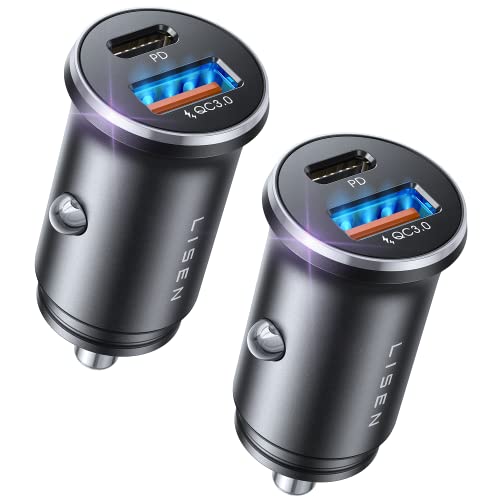
- Flush-fitting aluminum body minimizes dashboard clutter
- 36W USB-C PD and 18W USB-A QC ports
- Two-pack includes a 24-month replacement promise
Best For: Drivers who want a discreet charger for everyday use
Budget Dual-Port Pick

- Two USB-A ports for simultaneous charging
- Two-pack with safety protections
- Not USB-C PD; 3.4A maximum output
Best For: Affordable everyday charging for two USB-A devices
Family Road-Trip Pick
90W Four-Port USB-C Car Charger

- Two USB-C and two USB-A ports
- Up to 90W with PD/QC support
- Designed for 12–24V vehicles
Best For: Charging multiple mixed devices during road trips
Maximum-Port Pick
Six-Port Charger with Voltage Display

- Six USB-A and USB-C charging ports
- Voltage display monitors battery status
- Advertised up to 250W total power
Best For: High-capacity charging for groups and busy vehicles
Best Overall – Anker 323 52.5W Dual-Port Charger
The Anker 323 is a dependable pick among car USB chargers, combining a 30W USB-C PowerIQ 3.0 port with a 22.5W USB-A port. It is well suited to drivers who want fast charging for newer phones while keeping a second device powered.
Best For: Drivers who want trusted dual-device charging and broad phone compatibility.
Pros:
- Charges an iPhone 14 Pro to 50% in about 25 minutes through USB-C.
- Supports simultaneous charging from USB-C and USB-A ports.
- ActiveShield 2.0 monitors temperature and adjusts output for added protection.
Cons:
- No USB-C cable is included.
- Its total 52.5W output is lower than some three- or four-port alternatives.
The Anker 323 is a balanced, compact option for everyday commutes. Its reputable safety features, two-port layout, and strong USB-C performance make it an easy recommendation for most single-driver setups.
Best Multiport Value – KENHAO 67W Three-Port Charger
The KENHAO 67W is one of the more flexible car USB chargers for families and passengers, with two USB-C ports and one USB-A port. Its combination of PD and QC output can power phones, tablets, and other USB devices from 12V-24V vehicle sockets.
Best For: Families, road trips, and vehicles carrying several USB-C and USB-A devices.
Pros:
- Three ports support charging multiple devices at once.
- Provides up to 37W through USB-C and 30W through USB-A.
- Metal housing is designed for heat dissipation and shock resistance.
- Includes protection against over-current, over-voltage, overheating, and short circuits.
Cons:
- Charging performance depends on how power is distributed among connected devices.
- The supplied notes do not specify a cable included in the package.
Choose this model when port count matters more than the smallest possible footprint. Its broad compatibility and 67W rating make it a practical shared-car charger, particularly for longer trips.
Best for Cable-Free Convenience – LISEN 84W Retractable Charger
The LISEN 4-in-1 stands out among car USB chargers by building retractable USB-C and older iPhone charging cables directly into the unit. With additional USB ports and up to 84W of stated output, it helps reduce loose cables while charging several devices in the car.
Best For: Families, commuters, and drivers who want integrated cables and a tidier cabin.
Pros:
- Two retractable cables extend up to 31.5 inches.
- Can charge up to four devices simultaneously.
- 45W PD USB-C output is available with a 24V vehicle supply.
- 180-degree adjustable design helps position the charger conveniently.
Cons:
- With standard 12V sockets, peak USB-C output is limited to 36W.
- Not compatible with Micro-USB devices.
- Does not support CarPlay, Bluetooth, or data transfer.
This is a strong organizational choice rather than a simple compact adapter. Confirm your vehicle uses a compatible 12V cigarette lighter socket, and remember that the highest advertised USB-C output requires a 24V supply.
Best Compact Option – Anker 30W PowerIQ 3.0 Charger
The Anker 30W is a compact choice for car USB chargers when space is limited. It combines a fast 30W USB-C port with a USB-A port, allowing two phones or compatible devices to charge without taking up much room in the vehicle socket.
Best For: Solo drivers and couples who want a small, straightforward dual-port charger.
Pros:
- 30W USB-C output charges supported devices up to three times faster than standard 5W chargers.
- Ultra-compact design fits small spaces.
- Supports simultaneous USB-C and USB-A charging.
- Includes overvoltage, undervoltage, overcurrent, and over-temperature protection.
Cons:
- Total output is lower than the Anker 323 and other higher-wattage options.
- The supplied notes do not identify a charging cable included with the package.
For drivers who value minimal size and dependable everyday performance, this Anker model is a sensible fit. It offers the essential features without the bulk of a larger multiport charger.
Top Power Pick – 70W 3-Port USB-C Car Charger, 2-Pack
For drivers who want versatile car USB chargers, this two-pack combines a 40W USB-C PD port with two USB-A QC ports. Its 70W total output can charge up to three devices at once, making it useful for commutes, road trips, and shared vehicles.
Best For: Families, passengers, or anyone who regularly charges several phones, tablets, GPS units, or other USB devices in the car.
Pros:
- 70W total output with USB-C PD 3.0 and two USB-A QC 3.0 ports
- Charges up to three devices simultaneously
- Includes two compact chargers for multiple vehicles or a convenient spare
- Built-in protections against over-voltage, over-current, overheating, over-charging, and short circuits
Cons:
- The highest output is divided when multiple devices are connected
- Charging cables are not listed as included
This is a strong all-purpose option if maximum port flexibility matters. Its compact 12V–24V design fits cars, trucks, and SUVs, while the two-pack adds practical value for households with more than one vehicle.
Best Ready-to-Use Option – 67W 3-Port Car Charger with Cable
This 67W model is one of the more convenient car USB chargers for drivers who want fast charging without buying a separate cable. It has a 37W USB-C PD port, a 30W USB-A QC port, and a third USB port for charging compatible devices together.
Best For: Travelers who want a multi-port charger with a USB-C-to-USB-C cable included in the box.
Pros:
- 67W total output with USB-C PD up to 37W and USB-A QC up to 30W
- Supports simultaneous charging for USB-C and USB-A devices
- Includes a 3-foot USB-C-to-USB-C cable
- Safety protections cover over-current, over-voltage, overheating, and short circuits
Cons:
- Only one cable is included
- The product is supplied as a single charger rather than a two-pack
Choose this charger when included accessories and broad device compatibility are priorities. The one-year replacement coverage adds extra reassurance for regular travel use.
Best Compact Design – LISEN 69W Dual-Port Car Charger, 2-Pack
For a cleaner dashboard, this LISEN option keeps things simple with two ports rather than a larger multi-port layout. Among these car USB chargers, it stands out for its flush-fitting aluminum design, 36W USB-C PD output, and 18W USB-A QC output.
Best For: Daily drivers who prefer a small, low-clutter charger for one or two devices at a time.
Pros:
- Compact thumb-sized design sits flush in the cigarette lighter socket
- Aluminum-alloy shell is designed for heat dissipation and durability
- USB-C PD and USB-A QC ports support common phones, tablets, and accessories
- Two-pack is convenient for a second vehicle or backup, with a 24-month replacement promise
Cons:
- Lower overall port count than the three-port alternatives
- Notes indicate one port delivers full speed at a time for stable output
This is a practical pick for drivers who value a discreet, tidy installation over charging three devices simultaneously. The two-pack and replacement promise also make it suitable for shared vehicles or fleet use.
Budget Dual-Port Pick – Compact 3.4A USB Car Charger
If you need simple, dependable car USB chargers for two devices, this two-pack dual USB-A adapter is a practical choice. It delivers up to 3.4A total, includes a blue charging indicator, and is designed for standard 12V vehicle sockets.
Best For: Drivers who want an affordable two-pack for charging two USB-A devices at once.
Pros:
- Two USB-A ports can charge dual devices simultaneously.
- Compact ABS and PC fire-resistant construction with blue LED indicator.
- Includes over-current, overcharge, overheating, and short-circuit protection.
- Compatible with a broad range of phones, tablets, headphones, cameras, and other USB devices.
Cons:
- Uses USB-A ports only; it is not a USB-C PD charger.
- Maximum total output is 3.4A at 5V, so it is less powerful than newer high-wattage models.
This is a straightforward option for older cables, shared charging, or keeping a spare adapter in another vehicle. Choose a USB-C PD model instead if your devices require faster modern charging.
Family Road-Trip Pick – 90W Four-Port USB-C Car Charger
Among car USB chargers, this four-port adapter stands out for drivers carrying several USB-C and USB-A devices. It combines two USB-C and two USB-A ports with up to 90W of stated output, including PD and QC fast-charging support.
Best For: Families, passengers, and road-trip drivers who need to charge up to four devices from one socket.
Pros:
- Four ports—two USB-C and two USB-A—support simultaneous charging.
- Supports stated PD/QC output up to 90W, with PD 45W and QC 45W maximum outputs.
- Compatible with phones, tablets, laptops, cameras, GPS units, and other USB devices.
- Metal housing helps dissipate heat, while onboard protections guard against common electrical faults.
Cons:
- Charging performance depends on the device, cable, and available power.
- The adapter is intended for 12–24V vehicles, so vehicle specifications should be checked before purchase.
This is the most versatile choice of the three for mixed-device charging. Its four-port layout is especially useful when a single 12V socket must serve several passengers or electronics.
Maximum-Port Pick – Six-Port Charger with Voltage Display
For drivers who need the most connection capacity, this six-in-one adapter is one of the more expansive car USB chargers available. It provides six USB-A and USB-C ports, includes a voltage display for monitoring the vehicle battery, and advertises up to 250W total power.
Best For: Larger groups or drivers who regularly charge many phones and accessories from one cigarette-lighter socket.
Pros:
- Six USB-A and USB-C ports can charge multiple devices at the same time.
- Built-in voltage display helps monitor the vehicle battery status while connected.
- Supports stated fast-charging modes for compatible Huawei, OPPO, OnePlus, iPhone, Samsung, Vivo, Google, and other devices.
- Designed for extended charging with a focus on heat management and safety.
Cons:
- Its large port count may be unnecessary for solo drivers or minimal setups.
- Actual charging speed varies by device and supported charging standard.
- The supplied specifications list a 24V input, so vehicle compatibility should be confirmed before buying.
This model makes sense when six charging connections and battery-status monitoring matter more than a compact footprint. Verify your vehicle’s electrical specifications and your devices’ fast-charging requirements first.
How We Picked the Best Car USB Chargers
We focused on chargers with useful combinations of charging speed, port variety, compact designs, and practical vehicle compatibility. The selection includes single- and multi-device models, USB-C-focused options, dual-port adapters, and higher-output chargers for families or passengers.
Power ratings were considered alongside port configuration. A charger’s total wattage is shared across connected devices, so a high headline number is most useful when the adapter also supports sensible power distribution. We also looked for features such as retractable designs, voltage displays, bundled multipacks, and support for modern USB-C devices.
Quick Comparison
| Best For | What to Look For |
|---|---|
| Everyday phone charging | 30W USB-C output and compact size |
| Two or three devices | Multiple ports with clearly stated total wattage |
| Families and road trips | Three or more ports and strong combined output |
| Mixed older and newer devices | A combination of USB-C and USB-A ports |
| Multiple vehicles | A two-pack or compact adapter that is easy to move |
Key Buying Factors for Car USB Chargers
Output and Charging Protocols
For most current phones, a USB-C port rated around 20W to 30W is sufficient for fast charging. Larger tablets, handheld consoles, and laptops may require more power. Check whether the charger supports the protocol your device uses, such as USB Power Delivery or a manufacturer-specific fast-charging standard.
Port Count and Power Sharing
More ports are useful only if the adapter can distribute enough power across them. A four-port or six-port charger may be convenient for passengers, but simultaneous charging can lower the output available to each port. Review the total wattage as well as individual port ratings.
USB-C Versus USB-A
USB-C is generally the better choice for newer phones and tablets, while USB-A remains useful for older cables, accessories, and rear-seat devices. A combination of both port types provides the most flexibility for shared vehicles.
Fit, Heat, and Vehicle Compatibility
Confirm that the adapter fits securely in your vehicle’s 12V socket and does not interfere with nearby controls. Higher-output models can produce more heat, so dependable safety protections and unobstructed airflow matter. Features such as over-current, over-voltage, and temperature protection are worthwhile.
Who Should Buy Which Car USB Chargers?
Choose a compact 30W USB-C charger if you primarily need to charge one phone during daily driving. A dual-port model is a better match for drivers who regularly charge a phone and a second device. Families, rideshare drivers, and road-trip travelers should consider three- or four-port chargers with higher total output.
If your vehicle carries a mixture of older and newer electronics, select a charger with both USB-C and USB-A. Buyers who need chargers in more than one car may save money with a multipack. For drivers who want to monitor the vehicle’s electrical system while charging, a model with a voltage display adds useful visibility without requiring a separate accessory.