Dual-mode car head-up displays can combine OBD2 vehicle data with GPS speed readings, giving drivers a flexible way to monitor speed and selected engine information without looking down at the instrument cluster.
We’ve selected 10 models spanning plug-and-play OBD2+GPS units, compact windshield displays, large-screen options, and feature-rich gauges. Use the guide below to match display type, vehicle compatibility, and alert features to your driving needs.
Best 10 Dual Mode Car Head Up Displays Picks for 2026
Feature-Rich Pick

- Extensive OBD2 vehicle data and safety alerts
- Gesture control, 13 themes, and RGB lighting
- Includes acceleration and braking performance tests
Best For: Drivers wanting detailed monitoring and customization
Smart Gesture Pick

- Reads over 100 ECU data items in OBD2 mode
- 3.6-inch screen with 13 themes and gesture control
- Adds alarms, RGB lighting, and performance tests
Best For: Drivers wanting hands-free control and rich readouts
Simple Value Pick
Universal OBD II Dual-Mode HUD

- Plug-and-play support for OBD II or EUOBD vehicles
- Shows core speed, RPM, temperature, and voltage data
- Includes configurable units and automatic power control
Best For: Buyers seeking a straightforward essential-data HUD
Diagnostics Pick

- Scans and clears engine fault codes
- Provides OBD2 data plus GPS fallback mode
- Offers configurable alarms and performance tests
Best For: Compatible vehicle owners wanting HUD and diagnostics
Vehicle Data Choice
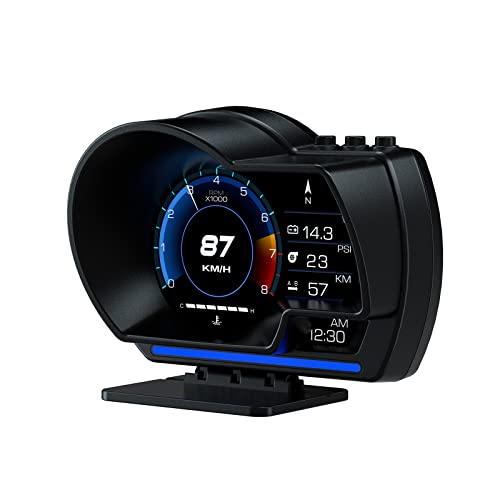
- Combines OBD and GPS display modes
- Shows speed, voltage, RPM, temperature, and more
- Dashboard or windshield mounting included
Best For: Drivers seeking a multifunction vehicle-data gauge
Projected Data Pick

- Projects large-font data onto the windshield
- Displays speed, RPM, temperature, voltage, and trip data
- Includes four alarms and automatic brightness
Best For: Owners of compatible gasoline cars wanting projected multi-data monitoring
Best GPS-Only Pick

- GPS+BDS positioning with a 10Hz refresh rate
- USB-powered without an OBD port
- Large display with automatic brightness
Best For: Simple GPS speed projection across USB-equipped vehicles
Best Dual-System Data Pick

- Switches between OBD2 and GPS modes
- Displays extensive engine and trip data
- Offers RGB colors and configurable alarms
Best For: Drivers wanting diagnostics and flexible display customization
Best Large-Screen Option

- Large 5.5-inch HD projected display
- Shows GPS speed and key engine readings
- Includes brightness control and fault functions
Best For: Drivers prioritizing readability and OBD2 vehicle information
Feature-Rich Pick – OBD2+GPS Dual-Mode Car HUD
This OBD2+GPS dual mode car head up display combines vehicle data, GPS support, gesture control, and configurable alerts in a compact 3.5-inch screen. OBD2/EOBD mode provides the broadest data set, while the included rotating bracket and Type-C cable support plug-and-play installation.
Best For: Drivers who want extensive vehicle information, performance testing, and customizable presentation.
Pros:
- Displays speed, RPM, coolant temperature, voltage, fuel consumption, compass, turbo pressure, and altitude in OBD2/EOBD mode.
- Offers 13 interface themes, gesture-based page switching, RGB lighting, and multiple language options.
- Includes overspeed, overheat, voltage, and fatigue-driving alerts, plus acceleration and braking tests.
- Uses separate chips for data calculation and screen rendering, with a 360-degree rotatable bracket.
Cons:
- The full data feature set is available only in OBD2/EOBD mode.
- Its many settings and display options may be more than casual drivers need.
With its broad monitoring range and enthusiast-focused testing tools, this is a strong choice for buyers seeking a highly customizable dual-mode HUD rather than a basic speed display.
Smart Gesture Pick – wiiyii OBD2+GPS Gauge HUD
The wiiyii is a versatile option among dual mode car head up displays, combining OBD2 data with universal GPS functionality. Its 3.6-inch high-definition screen, gesture control, alarms, and adjustable mounting make it suited to drivers who want information without repeatedly touching the display.
Best For: Drivers seeking a polished, gesture-controlled HUD with extensive data and performance features.
Pros:
- OBD2 reads more than 100 ECU data items, while GPS mode is described as universal across car models.
- Provides a 3.6-inch display, 13 themes, fast response, and touch-free interface switching.
- Includes speed, RPM, water temperature, voltage, fuel consumption, compass, turbo pressure, and altitude data.
- Offers independent warning lights, fatigue reminders, RGB atmosphere lighting, and acceleration/braking tests.
Cons:
- OBD2 compatibility varies by vehicle, so some cars may rely on GPS mode.
- The feature-rich design may be unnecessary for buyers who only need speed.
This model stands out for combining broad data coverage with a hands-free control method. It is particularly appealing if you value customization, visual alerts, and performance-oriented readouts.
Simple Value Pick – Universal OBD II Dual-Mode HUD
This universal dual mode car head up display focuses on essential driving information in a straightforward 3-inch format. It supports vehicles using OBD II or EUOBD, automatically powers on and off with the vehicle, and uses a high-definition display with reflection-reducing treatment.
Best For: Drivers who want a basic plug-and-play HUD for core engine and speed information.
Pros:
- Automatically adapts to cars that use OBD II or EUOBD and supports plug-and-play setup.
- Displays speed, engine RPM, water temperature, battery voltage, and multiple warning conditions.
- Supports kilometer/mile and Celsius/Fahrenheit switching for flexible viewing.
- Automatic startup and shutdown helps avoid leaving the display powered unnecessarily.
Cons:
- The 3-inch screen and listed feature set are more basic than those of the larger, feature-rich models.
- The supplied notes do not mention GPS functionality or advanced performance testing.
This is a practical choice when simplicity matters more than extensive customization. Its core readings and automatic power behavior make it a sensible entry-level option for compatible vehicles.
Diagnostics Pick – MH OBD2+GPS Gauge Display
The MH OBD2+GPS model is one of the more diagnostic-focused dual mode car head up displays. It combines real-time driving information with fault-code scanning and clearing, adjustable alerts, and GPS fallback for compatible vehicles that cannot use the full OBD2 data connection.
Best For: Owners of compatible post-2008 OBDII/EOBD vehicles who want diagnostics alongside HUD data.
Pros:
- Displays speed, tachometer, fuel consumption, water temperature, voltage, altitude, compass, clock, and other driving data.
- Can scan and clear engine fault codes, read live data streams, and perform acceleration/braking tests.
- Switches between OBD2 and GPS modes, with GPS providing speed, altitude, satellite time, direction, and trip information.
- Offers configurable speed, temperature, voltage, and RPM alarms, plus adjustable brightness and measurement units.
Cons:
- Compatibility is limited to OBDII/EOBD vehicles produced after 2008, with several listed brand and vehicle exclusions.
- Vehicles with incompatible OBD2 protocols receive GPS functionality only.
- It does not support OBD I or JOBD systems.
For buyers who want more than a visual speed aid, the MH adds useful code-reading and live-data functions. Confirming vehicle compatibility is essential before purchase because the supported vehicle list is comparatively specific.
GPS Precision Pick – White Dual-Mode Car HUD
For drivers comparing dual mode car head up displays, this compact GPS/BDS unit emphasizes quick installation, readable speed data, and flexible calibration. It plugs into a USB power source and displays speed in either MPH or KM/H.
Best For: Drivers who want a simple, portable GPS-based HUD with large numbers, brightness control, and an overspeed warning.
Pros:
- Uses dual-mode GPS and BDS with a 10Hz refresh rate and connection to up to 32 satellites.
- USB plug-and-play setup with switchable MPH/KM/H display.
- Offers manual speed calibration, adjustable brightness, and a customizable overspeed alert.
- Large anti-reflective display is designed for easy reading in daytime or nighttime conditions.
Cons:
- GPS performance can be affected in tunnels, underground garages, heavy rain, fog, or behind metallic windshield film.
- It primarily provides GPS-based speed information rather than the broader vehicle data available from an OBD connection.
This is a straightforward choice when speed visibility matters more than extensive engine metrics. Its small footprint and calibration feature make it practical for drivers who want a low-complexity installation.
Vehicle Data Choice – Wiiyii P6 OBD+GPS HUD
The wiiyii P6 stands out among dual mode car head up displays by combining OBD and GPS modes. It can show speed alongside vehicle information such as voltage, fuel consumption, RPM, and water temperature, with dashboard or windshield mounting options.
Best For: Drivers who want a multifunction gauge that can display more than speed and can use GPS when their vehicle does not support the OBD2 protocol.
Pros:
- Dual OBD+GPS operation provides a fallback GPS mode for vehicles without compatible OBD2 support.
- Can read more than 100 types of vehicle data through the OBD system, according to the supplied product notes.
- Includes adjustable dashboard or windshield installation with a rotary suction-cup bracket and 3M tape.
- Automatic brightness adjustment and a red ambient-light warning for abnormal driving conditions.
Cons:
- OBD features depend on vehicle compatibility; unsupported vehicles display GPS information only.
- The larger multifunction design may be less minimal than a basic speed-only HUD.
The P6 is the more data-focused option in this group. Choose it if monitoring vehicle readings is important, but confirm your car supports the required OBD2 protocol before relying on its expanded functions.
Projected Data Pick – MAIMEIMI OBD2 Windshield HUD
For shoppers evaluating dual mode car head up displays with broader vehicle monitoring, the MAIMEIMI MA-A8 uses an OBDII/EOBD connection to project information onto the windshield. It can show speed, RPM, trip data, water temperature, voltage, and fuel-use readings in different display modes.
Best For: Drivers with a compatible gasoline car who want windshield-projected vehicle data and multiple adjustable safety alerts.
Pros:
- Projects large-font information onto the windshield rather than requiring a glance down at the dashboard.
- Offers multiple data modes, including speed, RPM, trip, water temperature, voltage, L/h, and L/100KM.
- Includes overspeed, fatigue-driving, speed, and engine-failure alarms.
- Automatic brightness adjustment uses a built-in light sensor, with manual adjustment also available.
Cons:
- Compatibility is limited to supported OBDII/EOBD gasoline vehicles, generally from 2008 onward.
- The supplied notes list numerous incompatibilities, including some Dodge, Jeep, Chrysler, French, Italian, hybrid, diesel, pickup, RV, and modified-ECU vehicles.
- It does not support OBDI or JOBD systems.
This model is appealing when projected multi-data readouts and several alarms are priorities. Compatibility checking is essential, since its OBD-dependent features are not intended for every vehicle type.
Best GPS-Only Pick – Plug-and-Play Car HUD
For drivers comparing dual mode car head up displays but wanting a simple GPS-based setup, this compact HUD is a practical choice. Its GPS and BDS positioning, 10Hz refresh rate, large MPH display, and USB power make it easy to add projected speed information without using the vehicle’s OBD port.
Best For: Drivers who want a straightforward, USB-powered GPS speedometer for cars, trucks, or motorcycles.
Pros:
- Uses GPS+BDS positioning with a 10Hz refresh rate and support for up to 32 satellites.
- USB-powered at 5V, so it does not require an OBD connection.
- Automatic brightness adjustment helps accommodate daytime and nighttime driving.
- Large, anti-reflective MPH display is designed for quick reading.
Cons:
- Displays GPS-derived speed rather than vehicle diagnostic data.
- GPS accuracy and availability can be affected by tunnels, garages, weather, or metallic windshield film.
- A small speed deviation of approximately 0.6–1.8 MPH is normal.
This is the least complicated option of the three for buyers who prioritize installation flexibility and speed visibility. Choose it when USB compatibility matters more than OBD2 data such as RPM, temperature, or fault codes.
Best Dual-System Data Pick – OBD2+GPS Multifunction HUD
This OBD2+GPS unit is one of the more capable dual mode car head up displays for drivers who want both speed projection and broader vehicle information. OBD2 mode provides extensive engine data and fault-code functions, while GPS mode offers speed and navigation-related readings for vehicles that do not support OBD2.
Best For: Drivers seeking flexible OBD2 and GPS operation with customizable visuals and vehicle-monitoring features.
Pros:
- Offers separate OBD2 and GPS modes for broader vehicle compatibility.
- OBD2 mode can show data such as RPM, coolant temperature, voltage, fuel consumption, and engine load.
- Includes speed, temperature, RPM, voltage, and fatigue-driving alarms.
- Provides 11 RGB backlight colors, adjustable brightness, and MPH/KM/H support.
Cons:
- OBD2 installation requires access to the vehicle’s OBD2 port and cable routing.
- The extensive settings and data options may take longer to configure than a basic GPS display.
- Some readings depend on vehicle support for the relevant OBD2 parameters.
Its main advantage is versatility: use OBD2 for detailed vehicle information or switch to GPS mode when OBD2 support is unavailable. It is a strong fit for buyers who want a configurable gauge display rather than speed alone.
Best Large-Screen Option – 5.5-Inch OBD2 HUD
For buyers who prefer a larger projected interface, this 5.5-inch HUD combines GPS speed with OBD2 vehicle data. It is designed as a plug-and-play accessory for compatible cars, SUVs, and trucks, with automatic brightness adjustment and alerts for selected vehicle conditions.
Best For: Drivers who want a large, easy-to-see display with speed, engine information, and basic OBD2 diagnostic functions.
Pros:
- Uses a 5.5-inch HD display for prominent windshield-projected information.
- Shows GPS speed in MPH or KM/H along with RPM, water temperature, voltage, and fuel consumption.
- Includes automatic brightness adjustment for changing light conditions.
- Can read failure information and clear failure codes through OBD2 functions.
Cons:
- Requires an OBD2/EOBD-compatible vehicle for its primary plug-and-play setup.
- The larger housing may occupy more dashboard space than compact HUD units.
- Vehicle data availability can vary by car and supported OBD2 parameters.
This model emphasizes readability and a broad dashboard view rather than minimal size. It makes sense for drivers who want a large display and useful engine-status information in one unit, provided their vehicle supports OBD2/EOBD.
How We Picked the Best Dual Mode Car Head Up Displays
We focused on models that support both OBD2 and GPS operation, or clearly offer multiple operating modes for broader vehicle compatibility. We also considered setup simplicity, display readability, available information, windshield projection, speed-unit support, and practical alerts such as overspeed warnings or fault notifications.
Because specifications and vehicle support can vary, check each model’s listed OBD2/EOBD compatibility before buying. GPS mode is especially useful when a vehicle does not support the required OBD2 protocol.
Quick Comparison
| Type | Best For | Typical Strength |
|---|---|---|
| OBD2+GPS dual system | Flexible everyday use | Vehicle data plus GPS fallback |
| GPS-only display | Older or incompatible vehicles | Simple speed monitoring |
| Large-screen HUD | Maximum readability | Prominent MPH/KM/H display |
| Multi-gauge display | Data-focused drivers | Speed, RPM, temperature, voltage, and alerts |
Key Buying Factors for Dual-Mode Car Head-Up Displays
Compatibility and Installation
Confirm that your vehicle uses a compatible OBD2 or EOBD interface and that the included cable can reach a suitable mounting position. Plug-and-play designs are generally easier to install, while GPS mode avoids dependence on vehicle diagnostics.
Display Clarity
Look for adjustable brightness, clear numerals, suitable screen size, and a stable windshield projection. A larger display can be easier to read, but it may occupy more of your forward view. Color and backlight adjustments can help in changing light conditions.
Useful Information and Alerts
Decide whether you only need speed or also want RPM, coolant temperature, battery voltage, fuel-related information, diagnostic codes, or overspeed warnings. More data is useful only when the controls and screen remain easy to understand while driving.
Units and GPS Behavior
Drivers who switch between regions should verify MPH and KM/H support. GPS speed can differ slightly from the vehicle speedometer, particularly during acceleration, braking, or poor satellite reception, so treat the display as an aid rather than a replacement for safe driving judgment.
Who Should Buy Which Dual Mode Car Head Up Displays?
Choose an OBD2+GPS dual-system model if you want the broadest flexibility and access to both speed and vehicle information. Choose a GPS-focused HUD for an older vehicle, a nonstandard diagnostic system, or a simple installation that only needs speed.
Choose a large-screen model if quick readability is your top priority, especially for longer trips. Choose a multi-gauge display if you regularly monitor engine temperature, voltage, RPM, or overspeed alerts. Before finalizing your choice, prioritize compatibility, mounting position, brightness, and distraction-free readability over the number of extra metrics.