Choosing the right downdraft sanding table can improve dust control, surface prep, and day-to-day workflow in a busy body shop.
Below, we compare 10 strong options for different shop sizes, power setups, and sanding demands so you can narrow the field quickly.
Best 10 Downdraft Sanding Tables for Body Shops Picks for 2026
Compact Benchtop Downdraft Table
Shop Fox W1734A 15x25 Downdraft Sanding Table

- 15" x 25" benchtop design for small workspaces
- Internal baffles help maximize air movement
- Non-skid top and feet improve stability
Best For: Small shops needing a lightweight benchtop sanding station
Heavy-Duty Metalworking Station
Grizzly G0798 24x62 Downdraft Table
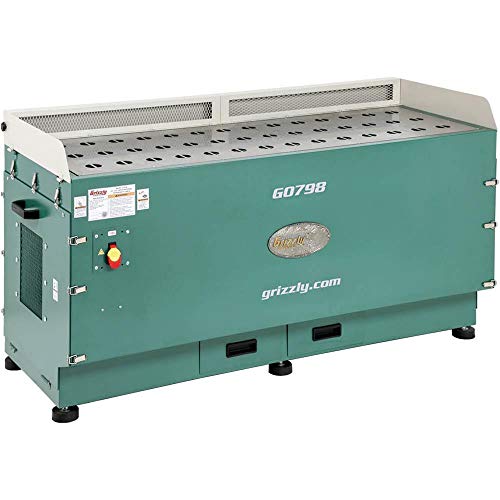
- 24" x 62" work surface offers plenty of room
- 352-pound weight points to a sturdy setup
- Caster base can help with shop positioning
Best For: Large shops wanting a sturdy downdraft worktable
Large Format Sanding Table
Dynabrade 33x41 Downdraft Sanding Table

- 33" x 41" surface gives a larger sanding area
- 230 V, 1 phase, 60 Hz power requirement
- Clear fit for shops with compatible electrical service
Best For: Shops that already have 230 V power and want more surface area
Extra-Long Production Table
Grizzly G0631 28x79 Extra-Long Downdraft Table

- 25-1/4" x 76-1/4" table surface is extra long
- Two 1 HP motors are listed
- 1437 x 2 CFM without filters is specified
Best For: Busy shops needing a long, high-capacity downdraft table
Heavy-Duty 230V Shop Pick
Dynabrade 64208 33" x 41" Downdraft Table
- 230 V, 3 phase, 60 Hz power
- 33" x 41" sanding surface
- Designed to improve safety and finishes
Best For: Shops with 230 V, 3-phase power seeking a durable sanding station
Most Versatile 115V Choice
Dynabrade 64201 33" x 41" Downdraft Table
- 115 V, 1 phase, 60 Hz power
- Dual filtration with two included filters
- Casters, storage, and anti-slip coated top
Best For: Shops wanting a feature-packed 115 V downdraft sanding table
High-Voltage Industrial Option
Dynabrade 63208 33" x 41" Downdraft Table
- 460 V, 3 phase, 60 Hz power
- Built to improve safety and finishes
- Durable, long-lasting design
Best For: Industrial shops with 460 V three-phase power
Compact Power Shop Downdraft

- 33" x 60" sanding area
- 230 V, 3 phase, 60 Hz
- Durable, easy-to-use build
Best For: Body shops needing a durable sanding table with a smaller footprint
Filter-Ready Mobile Station

- Dual filtration with 1-micron filters
- Rhino Linings coated, anti-slip top
- 5" casters and storage compartments
Best For: Shops that need filtration, mobility, and tool storage
Large-Format Heavy Duty Downdraft

- 48" x 96" sanding area
- Up to 70% more filter area
- All-metal build with twin motors
Best For: Larger shops that need a spacious, heavy-duty sanding table
Compact Benchtop Downdraft Table – Shop Fox W1734A 15×25 Downdraft Sanding Table
For body shops looking for a compact downdraft sanding table for body shops, the Shop Fox W1734A is a simple benchtop option built around a 15″ x 25″ work surface. Its internal baffles are designed to maximize air movement, while the non-skid top and feet help keep the table stable during sanding tasks.
Best For: Small shops that want a lightweight benchtop downdraft table with basic dust-control support.
Pros:
- Compact 15″ W x 25″ L benchtop design fits smaller work areas.
- Internal baffles are intended to maximize air movement.
- Non-skid top and feet add stability during use.
- 2-1/2″ dust port supports dust collection hookup.
Cons:
- At 13.4 pounds, it is a lighter-duty table than full-size shop units.
- The 15″ x 25″ surface may be limiting for larger panels.
Overall, this is a practical pick if you need a straightforward, space-saving sanding station rather than a large production table. The lightweight build and compact footprint make it easy to place on a bench, but the smaller working area means it is best suited to modest jobs.
Heavy-Duty Metalworking Station – Grizzly G0798 24×62 Downdraft Table
If you need downdraft sanding tables for body shops that lean toward heavy-duty shop use, the Grizzly Industrial G0798 offers a large 24″ x 62″ metalworking table with a painted finish and caster base. Its 352-pound weight suggests a substantial stationary setup rather than a portable bench accessory.
Best For: Shops that want a large, sturdy downdraft table on casters for heavier-duty sanding or metalworking tasks.
Pros:
- Large 24″ x 62″ table size provides generous working space.
- Heavy 352-pound build supports a more stable shop setup.
- Caster base can make repositioning easier in the shop.
- Painted finish is listed for the frame and body.
Cons:
- No airflow, motor, or dust-port specs are provided in the notes.
- Very heavy at 352 pounds, so it is not a portable option.
This is a size-first option for body shops that value workspace and mass over portability. Because the supplied details do not include suction performance, it is best evaluated as a large, durable downdraft worktable rather than a spec-heavy dust-collection solution.
Large Format Sanding Table – Dynabrade 33×41 Downdraft Sanding Table
Among downdraft sanding tables for body shops, the Dynabrade 64205 stands out for its larger 33″ x 41″ footprint and 230 V, 1-phase, 60 Hz electrical requirement. The supplied details focus on size and power compatibility, which makes it a straightforward fit for shops that already have the right electrical setup.
Best For: Shops with 230 V power that need a larger downdraft sanding surface.
Pros:
- 33″ W x 41″ L work surface offers a roomy sanding area.
- 230 V, 1 phase, 60 Hz specification is clearly listed.
- Suitable for shops that want a dedicated large-format table.
Cons:
- No airflow, dust-port, or weight details are provided in the notes.
- Requires 230 V power, so it is not a simple plug-in choice for every shop.
This model is best approached as a size-and-power match rather than a spec-rich all-rounder. If your shop already runs 230 V equipment and you want a wider sanding area, it offers a clean fit; if you need detailed dust-collection data, the supplied notes leave that question open.
Extra-Long Production Table – Grizzly G0631 28×79 Extra-Long Downdraft Table
For body shops comparing downdraft sanding tables for body shops, the Grizzly G0631 is the largest option here by overall length, with a 25-1/4″ x 76-1/4″ table surface and twin 1 HP motors. The notes also list 1437 x 2 CFM without filters, making it a strong candidate for shops that want a production-style downdraft setup.
Best For: Busy shops that need a very long downdraft table with twin motors and high listed suction capacity.
Pros:
- Extra-long 25-1/4″ x 76-1/4″ surface supports large workpieces.
- Two 1 HP, 110V single-phase motors are listed.
- Air suction capacity is stated at 1437 x 2 CFM without filters.
- 490-pound load capacity suggests a robust work platform.
Cons:
- At 468 pounds, it is extremely heavy and not portable.
- Wood construction may be less durable than all-metal alternatives in some shops.
This is the most production-oriented table in the group, with the size and twin-motor setup to match larger sanding tasks. If your priority is maximizing working length and listed airflow capacity, it is the most aggressive option here, but it also demands serious floor space and a permanent shop location.
Heavy-Duty 230V Shop Pick – Dynabrade 64208 33" x 41" Downdraft Table
For body shops that already run 230 V three-phase power, this downdraft sanding table offers a straightforward way to improve sanding safety, process time, and finish quality. Its 33" x 41" work area gives technicians a practical surface for controlled sanding operations in a professional setting.
Best For: Shops with 230 V, 3-phase electrical setup that want a durable downdraft sanding table focused on safety and finish improvement.
Pros:
- Built for 230 V, 3 phase, 60 Hz shop power
- Designed to improve operator safety, process time, and finishes
- Durable, long-lasting construction
- Backed by a limited warranty
Cons:
- Power requirements limit where it can be installed
- No filtration, caster, or storage details were provided
- Less flexible for shops without 230 V three-phase service
This is the more utility-focused option in the lineup, aimed at established body shops that can support its electrical requirements. If your priority is a dependable sanding station for improving workflow and finish results, it fits that brief well.
Most Versatile 115V Choice – Dynabrade 64201 33" x 41" Downdraft Table
This downdraft sanding table for body shops is the most feature-rich option here, especially if you want dust control and everyday shop convenience. It is designed to eliminate airborne dust and contaminants while sanding, and it pairs a 33" x 41" work area with practical extras that support regular use.
Best For: Shops that need a 115 V downdraft sanding table with dust control features, mobility, and tool storage.
Pros:
- Eliminates airborne dust and contaminants while sanding
- 115 V, 1 phase, 60 Hz configuration
- Dual filtration with two included 1-micron pleated paper filters
- Rhino Linings coated tabletop, storage compartments, and 5" casters
Cons:
- Large unit at 248 pounds
- Only compatible with 115 V, 1 phase power
- Filter replacements will be part of ongoing use
For many body shops, this is the easiest balance of utility and setup because it runs on standard 115 V service. The combination of filtration, anti-slip surface, storage, and casters makes it the most practical all-around pick in this group.
High-Voltage Industrial Option – Dynabrade 63208 33" x 41" Downdraft Table
Among downdraft sanding tables for body shops, this model is built for shops that can support 460 V three-phase service. It shares the same 33" x 41" working footprint as the other large Dynabrade tables and is positioned as a durable tool meant to improve operator safety, process time, and finishes.
Best For: Industrial body shops with 460 V, 3-phase power that want a durable downdraft sanding table.
Pros:
- 460 V, 3 phase, 60 Hz power requirement
- Designed to improve safety, process time, and finishes
- Durable and long lasting
- Backed by a limited warranty
Cons:
- Requires high-voltage 460 V shop power
- No filtration, caster, or storage features were listed
- Not a fit for standard low-voltage shops
This is the most specialized pick in the set, so it makes sense only where 460 V power is already available. If your shop has the electrical setup and wants a no-frills, durable sanding table, this model is the clear match.
Compact Power Shop Downdraft – Dynabrade 64209 33" x 60"
If you need downdraft sanding tables for body shops in a space-conscious setup, the Dynabrade 64209 keeps the focus on durability and simple operation. Its 33″ x 60″ working area and 230 V, 3 phase, 60 Hz power setup make it a straightforward fit for shops that want a dedicated sanding station from a trusted tool brand.
Best For: Body shops that want a durable downdraft sanding table with a moderate footprint and straightforward industrial power requirements.
Pros:
- 33″ x 60″ working area for everyday sanding tasks.
- 230 V, 3 phase, 60 Hz power specification.
- Built as a high quality, durable, long lasting tool.
- Easy to use with a limited warranty.
Cons:
- No dust filtration or airflow performance details are provided in the notes.
- Power requirements may limit where it can be installed.
Overall, this model reads like a no-frills industrial option for shops that already have the right electrical setup and want a dependable sanding table from Dynabrade.
Filter-Ready Mobile Station – Dynabrade 63209 33" x 60"
For body shops comparing downdraft sanding tables for body shops, the Dynabrade 63209 stands out with dust-control details that are clearly spelled out. It offers a 33″ x 60″ working area, dual filtration that accepts 1-micron pleated paper filters, a Rhino Linings coated tabletop, and casters for easier movement around the shop.
Best For: Shops that want a mobile downdraft sanding table with built-in filtration details and accessory storage.
Pros:
- Dual filtration with 1-micron pleated paper filters included.
- Rhino Linings coated tabletop is durable and anti-slip.
- Two storage compartments help keep tools and accessories close.
- 5″ casters make the table easier to maneuver.
Cons:
- 460V, 3 phase, 60 Hz power requirement may not suit every shop.
- Working area is smaller than the 48″ x 96″ model in this group.
This is a practical pick if filtration, mobility, and a usable work surface matter more than maximum size. The included filter setup and coated top make it especially well matched to busy shop environments.
Large-Format Heavy Duty Downdraft – Dynabrade 64657 48" x 96"
If your shop needs a larger downdraft sanding table for body shops, the Dynabrade 64657 is built around a big 48″ x 96″ working area. The notes also call out up to 70% more filter area than competitive brands, dual filtration with a pre-filter blanket and 1-micron paper filters, and heavy-duty twin electric motors.
Best For: Larger body shops that want a spacious sanding table with heavy-duty construction and expanded filter area.
Pros:
- 48″ x 96″ working area provides a generous sanding surface.
- Up to 70% more filter area than competitive brands.
- Dual filtration includes a pre-filter blanket and 1-micron paper filters.
- All-metal construction with CNC milled 3/4″ MDF tabletop and heavy-duty twin motors.
Cons:
- 970-pound weight makes it a major permanent installation.
- 115V, 1 phase, 60 Hz setup may still require shop-side planning.
Among these options, this model is the clear size-and-capacity pick. It is best suited to shops that have the room and power to support a larger, more robust sanding station.
How We Picked the Best Downdraft Sanding Tables for Body Shops
We focused on the features that matter most in production environments: table size, usable work surface, airflow capacity, dust capture efficiency, electrical requirements, and how well each unit fits common body shop tasks like panel prep and sanding small parts.
We also looked at versatility. Some shops need compact tables for tight spaces, while others need extra-long or extra-wide surfaces for larger panels and higher throughput.
Quick Comparison: Which Type Fits Your Shop?
Smaller tables are a better match for occasional prep work, limited floor space, or shops that handle mostly smaller components. Mid-size units offer a balanced footprint for general collision repair and refinishing tasks. Larger tables are the better choice when you want to support full panels, reduce repositioning, and keep multiple technicians moving efficiently.
Compact Vs. Mid-Size Vs. Large
Compact models prioritize space savings and easier placement. Mid-size Downdraft Sanding Tables for Body Shops tend to offer the best balance of flexibility and footprint. Large-format units are ideal when workflow speed and work-area coverage matter more than conserving space.
Key Buying Factors for Downdraft Sanding Tables for Body Shops
Table dimensions: Make sure the surface matches the parts you sand most often. Longer tables help with doors, hoods, and larger panels.
Airflow and capture: Strong, even downdraft performance helps pull dust away from the operator and the workpiece. Consistent airflow across the surface is more important than raw specs alone.
Power compatibility: Confirm whether the unit is 115V, 460V, single-phase, or three-phase. Electrical compatibility can be the deciding factor in real-world installation.
Shop footprint: Measure not just the table itself, but also clearance for operators, hoses, and material handling.
Build and serviceability: In a body shop, durable construction and easy maintenance matter because downtime affects productivity.
Who Should Buy Which Downdraft Sanding Tables for Body Shops?
If you run a small collision repair bay or need a secondary prep station, a compact table is usually the most practical choice. If your shop handles mixed repair work and wants one all-purpose solution, a mid-size model is often the safest buy.
If you process larger panels, have multiple technicians, or need better support for high-volume refinishing work, choose a larger downdraft table. For shops with strict electrical constraints, prioritize the power configuration first and size second so the unit integrates cleanly into your existing setup.
In short, the best choice depends on space, airflow needs, and the types of parts your team sands every day. Matching those factors to the right table will do more for productivity than chasing the largest model on paper.