Choosing the right paint thickness gauge can save time, reduce guesswork, and help spot repairs before they become costly surprises.
This roundup focuses on practical, shop-ready options for fast measurements, used-car checks, and bodywork inspection.
Best 10 Paint Thickness Gauges for Body Shops Picks for 2026
Factory-Calibrated Auto Pick
CM-224 Auto Paint Thickness Gauge

- Factory-calibrated for immediate use
- Detects Fe, NFe, and Fe+Zn automatically
- 0.1 μm resolution with backlit LCD
Best For: body shops and used-car inspections on metal panels
Simple Mechanical Budget Pick
Car Body Damage Detector Paint Tester

- No batteries required
- Magnetic tip for curved areas
- Portable pen-style design
Best For: budget-friendly quick checks on painted metal
Mixed-Metal Inspection Pick
CM-205FN Paint Thickness Gauge

- Factory calibrated with backlit LCD
- Auto-detects Fe and NFe substrates
- SNG and CON modes for faster inspections
Best For: shops and inspectors working on steel and aluminum panels
Advanced Filler-Check Pick
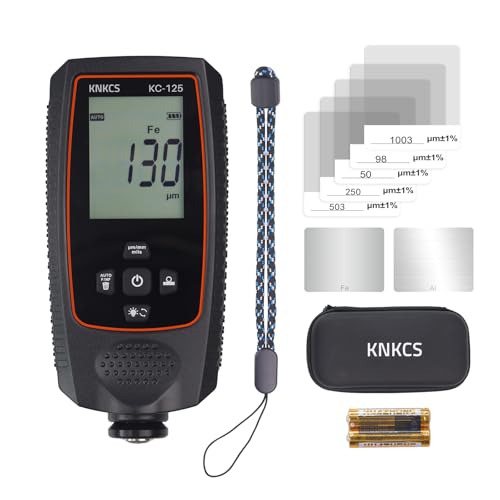
- 0–2000 μm range for broader coverage
- Detects iron powder filler and iron-zinc coatings
- Continuous measurement for faster workflows
Best For: used-car checks and body shops needing filler detection
Digital Fe/NFe Paint Gauge

- Auto detects Fe/NFe substrates
- Stores up to 50 readings
- Large LCD with µm/mm/mil display
Best For: Technicians and buyers who want digital paint checks with built-in stats
Magnetic Bodywork Tester

- No batteries required
- Color-coded manual scale
- Pocket-friendly pen shape
Best For: Used car inspections and quick basic paint checks
Professional Coating Gauge

- High-precision digital readings
- USB export for records
- Auto Fe/NFe substrate detection
Best For: Inspectors and detailers who need precise readings and PC export
Budget-Friendly Digital Gauge
KREFINISH Paint Thickness Gauge Car Digital Accurate Mil Coating Thickness Meter

- 0-2000 µm range with statistics display
- Fe/NFe auto detection and backlit LCD
- Factory calibrated and ready to use
Best For: General automotive paint inspection on a budget
High-Detail Panel Scanner
CM-206X Automotive Coating Thickness Meter

- 0-59.1 mil range with 0.001 mil resolution
- Auto detects Fe, NFe, and Zn surfaces
- Ruby probe and portable case for field use
Best For: Detailed vehicle panel inspections and mobile appraisals
Shop Data Tracker
Coating Thickness Gauge, Paint Thickness Meter for Fe and NFe Metals
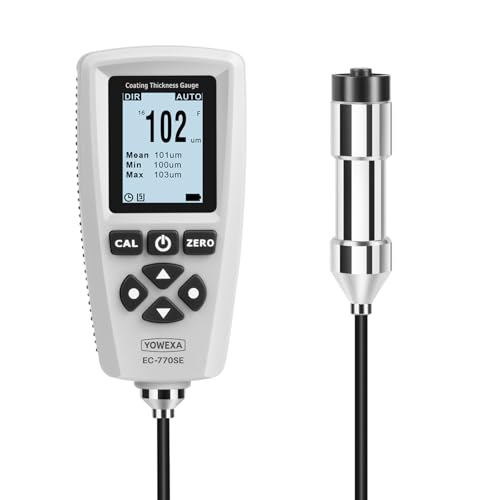
- 0-2000 µm range with ±2%+1 µm accuracy
- Stores 2000 readings and exports via USB
- External probe and alarm functions for QC
Best For: Shops that need logged readings and inspection records
Factory-Calibrated Auto Pick – CM-224 Auto Paint Thickness Gauge
If you want paint thickness gauges for body shops that are ready to use right away, the CM-224 Auto is built for fast vehicle checks. It’s factory calibrated, detects Fe, NFe, and Fe+Zn substrates automatically, and gives a clear backlit readout for paint, repaint, and filler inspection on metal panels.
Best For: Body shops, used car inspectors, and appraisers who need quick, accurate checks on steel, aluminum, and galvanized panels.
Pros:
- Factory-calibrated and ready to use after battery installation
- Automatic Fe / NFe / Fe+Zn detection for mixed vehicle materials
- 0.1 μm resolution with single and continuous measuring modes
- Backlit LCD and simple controls for easy on-site use
Cons:
- Designed only for metal surfaces, not plastic or composite parts
- Advanced calibration is optional, so casual users may not need all features
Overall, this is a strong fit when speed, substrate recognition, and straightforward operation matter most. It’s especially practical for inspection workflows where you need to check panels quickly and move on to the next car.
Simple Mechanical Budget Pick – Car Body Damage Detector Paint Tester
For buyers comparing paint thickness gauges for body shops on a budget, this pen-style mechanical tester keeps things simple. It uses a magnetic tip, a colored thickness scale, and no batteries, so it’s easy to carry and use for quick checks on painted metal surfaces.
Best For: Users who want a low-cost, no-battery paint checker for quick visual inspection and portable use.
Pros:
- No batteries needed, so it’s always ready to use
- Magnetic tip helps with curved and hard-to-reach areas
- Small pen-like shape makes it easy to carry
- Water-resistant design for use in wet or dirty conditions
Cons:
- Mechanical, so it won’t offer digital readout precision
- Best suited to quick checks rather than detailed inspection workflows
This is a practical choice if you want a simple field tool instead of a more advanced digital meter. It trades detailed measurement features for convenience, portability, and low upkeep.
Mixed-Metal Inspection Pick – CM-205FN Paint Thickness Gauge
This CM-205FN is a solid option if you need paint thickness gauges for body shops that can handle modern mixed-material vehicles. It’s factory calibrated, automatically detects Fe and NFe substrates, and offers a clear backlit LCD with dual measuring technology for accurate coating checks on metal panels.
Best For: Body shops, appraisers, and pre-purchase inspectors working on steel and aluminum body panels.
Pros:
- Factory calibrated and ready to use out of the box
- Automatic Fe / NFe detection reduces manual switching
- 0.1 μm resolution and ±(3%+2 μm) accuracy for detailed checks
- SNG and CON modes support spot checks and fast scanning
Cons:
- Limited to metal substrates only
- Does not include Fe+Zn identification like some higher-end models
For everyday automotive inspection, this model balances accuracy, speed, and ease of use well. It’s a practical choice if your work often involves steel and aluminum panels and you want a straightforward digital gauge.
Advanced Filler-Check Pick – KC-125 Paint Thickness Gauge
When you need paint thickness gauges for body shops that go beyond basic readings, the KC-125 adds broader range and material recognition features. It measures from 0–2000 μm, supports continuous measurement, and includes iron powder filler recognition plus iron-zinc coated substrate identification for more detailed inspection work.
Best For: Professionals who want a wider-range gauge for used car checks, filler detection, and general shop inspection.
Pros:
- 0–2000 μm range covers more coating situations
- 0.1 μm resolution with ±(3% + 1 μm) accuracy
- Recognizes iron powder filler and iron-zinc coated substrates
- Continuous measurement helps speed up inspection work
Cons:
- No backlit LCD is mentioned in the supplied specs
- Broader feature set may be more than casual users need
This model is a good fit for more involved inspection tasks where filler detection and a wider measurement range matter. It looks especially useful in used-car evaluation and shop environments where quick, repeatable readings save time.
Digital Fe/NFe Paint Gauge – HW-300PRO Precision Meter
If you need paint thickness gauges for body shops that can handle more than basic spot checks, the HW-300PRO is built for measuring coatings on steel and aluminum with automatic Fe/NFe detection. It reads in µm, mm, or mils, records statistical data, and includes a large LCD that shows mode, battery status, and substrate type for practical inspection work.
Best For: Technicians, body shop users, and car buyers who want a digital gauge with stats and auto substrate detection.
Pros:
- Automatic Fe/NFe detection using electromagnetic induction and eddy current methods.
- Records average, maximum, minimum, and difference values, with support for up to 50 readings.
- Large LCD display shows metal type, operating mode, battery status, and measurement units.
- Compact design with auto shutoff to help conserve battery life.
Cons:
- It is designed for metal substrates, not plastic or composite panels.
- The description is focused on coating measurement rather than advanced reporting features beyond on-device stats.
Overall, this is a versatile digital option for body shop inspections where automatic substrate detection and quick statistical checks matter. It is a practical pick if you want a small, feature-rich gauge for routine paint evaluation.
Magnetic Bodywork Tester – No-Battery Paint Checker
For simple paint thickness gauges for body shops, this magnetic tester keeps the process straightforward: no batteries, no setup, and a color-coded scale for reading coating and filler layers. Its pen-shaped form makes it easy to carry for used car inspections, and the magnetic tip is intended to work even on dirty or wet surfaces.
Best For: Used car shoppers, appraisers, and anyone who wants a simple no-battery inspection tool.
Pros:
- Magnetic tip works without batteries, making it handy for outdoor inspections.
- Color-coded scale helps you read paint thickness and filler layers quickly.
- Lightweight, pen-shaped design is easy to store in a glove box or tool kit.
- Built for quick checks of prior repairs or repainting on vehicle bodies.
Cons:
- It is a manual tester, so it does not offer digital readouts or data storage.
- The description does not list detailed measurement ranges or statistical functions.
This is a practical low-friction choice if you want a fast visual inspection tool rather than an electronic gauge. It fits best as a pocketable check for spotting bodywork inconsistencies during used car evaluations.
Professional Coating Gauge – CM-208FN USB Export Meter
Among paint thickness gauges for body shops, the CM-208FN is aimed at users who want precise readings, automatic Fe/NFe detection, and the ability to export measurements to a PC. It measures coatings on metal substrates only, shows statistical data on device, and uses an integrated ruby-tip probe for fast one-hand operation on flat and moderately curved panels.
Best For: Inspectors, detailers, and technicians who need high-precision digital measurements with data export.
Pros:
- High-resolution measurement output with multiple resolution steps for precise inspection work.
- Automatic Fe/NFe identification reduces manual switching and user error.
- Integrated ruby-tip sensor supports quick one-hand measurements.
- USB data export helps with reporting, comparison, and documentation.
Cons:
- Works only on metal substrates, so it is not suitable for plastic or composite materials.
- The feature set is more specialized than a basic handheld checker.
This model stands out if your workflow needs repeatable measurement, stats, and computer transfer rather than a simple go/no-go test. It is a strong shop-ready option for more serious coating inspection tasks.
Budget-Friendly Digital Gauge – KREFINISH Paint Thickness Gauge Car Digital Accurate Mil Coating Thickness Meter
If you need paint thickness gauges for body shops that cover the basics well, this KREFINISH model offers a practical 0-2000 µm range, Fe/NFe auto detection, and a backlit display for quick panel checks. It’s a straightforward choice for spotting inconsistencies on used vehicles, refinished panels, and other metal surfaces without a complicated setup.
Best For: Shops and used-car buyers who want an easy-to-use digital gauge for general automotive paint inspection.
Pros:
- Measures 0-2000 µm with ±(3%+1 µm) accuracy and statistics for average, min, max, and count.
- Automatically detects Fe and NFe substrates, including iron powder filler and iron-zinc coated substrates.
- Factory calibrated, battery-ready, and includes a high-contrast backlit LCD and auto shutoff.
- Useful for automotive paint, powder coating, and metal surface finishing checks.
Cons:
- Cannot be used on non-metallic materials like plastic, fiberglass, or wood.
- Accuracy is good for general inspection, but not as detailed as some higher-spec shop meters.
For body-shop and used-car inspection work, this gauge gives you the core features needed to compare panel readings and flag possible repair work. It’s a solid utility tool if you want a simple, readable meter that’s ready to go out of the box.
High-Detail Panel Scanner – CM-206X Automotive Coating Thickness Meter
For paint thickness gauges for body shops that need finer detail, the CM-206X is built for panel-to-panel comparison with a 0-59.1 mil range and very fine 0.001 mil resolution. It’s aimed at buyers, dealerships, and inspectors who want to spot coating differences across doors, hoods, roofs, and quarter panels during a full vehicle walkaround.
Best For: Buyers and mobile inspectors who want a compact, high-resolution gauge for detailed vehicle panel checks.
Pros:
- Measures 0-59.1 mils with 0.001 mil resolution for detailed comparison work.
- Automatically detects Fe, NFe, and Zn substrates for mixed-material vehicles.
- Ruby probe is designed for stable, controlled contact and reduced tip wear.
- Backlit multi-unit display and compact carrying case support field use.
Cons:
- Lower maximum range than 2000 µm-class meters, so it’s more specialized for automotive coatings.
- Requires vertical probe placement to get the intended reading flow.
This model stands out when the goal is fine panel comparison rather than broad industrial measurement. Its resolution, auto substrate detection, and portable design make it a strong fit for inspection routines where consistency matters.
Shop Data Tracker – Coating Thickness Gauge, Paint Thickness Meter for Fe and NFe Metals
If your workflow needs paint thickness gauges for body shops with storage and reporting features, this meter goes beyond basic spot checks. It measures 0-2000 µm, supports Fe/NFe metal testing, and adds data logging, USB export, and alarm functions for more organized inspection work.
Best For: Body shops and QC users who need saved readings, exports, and repeatable measurement records.
Pros:
- 0-2000 µm measurement range with ±2%+1 µm accuracy.
- Stores up to 2000 readings in four groups and supports USB export.
- Offers AUTO, MAG, and EDDY modes plus high/low alarms for QC work.
- External probe helps reach curved, recessed, and hard-to-access metal areas.
Cons:
- Only suitable for metal surfaces; not for plastic, wood, glass, or concrete.
- Bulkier than simpler handheld gauges because of the external probe and data features.
This is the most record-oriented option in the group, making it a better match for shops that need documentation as much as measurement. If you want a gauge that can support inspections, reporting, and repeat QC checks, it’s a strong candidate.
How We Picked These Paint Thickness Gauges for Body Shops
We prioritized tools that make sense in real repair and inspection workflows: clear metal substrate detection, useful thickness ranges, reliable repeatability, and displays that are easy to read in a busy bay. For Paint Thickness Gauges for Body Shops, accuracy matters, but so does speed, durability, and whether the device can help distinguish factory paint from repainted or repaired panels.
Quick Comparison
Most of the picks fall into two groups: digital gauges with automatic Fe/NFe detection for faster, more versatile use, and magnetic/manual-style testers that are simpler and often better for quick crash checks. Digital models are usually the better fit for comprehensive inspections, while basic testers can be useful as backup tools or for fast screening.
Key Buying Factors for Paint Thickness Gauges for Body Shops
Material Detection
Look for Fe/NFe or Fe/NFe/Zn support so the gauge can handle steel, aluminum, and zinc-coated panels. That matters on modern vehicles where mixed materials are common.
Range and Resolution
A practical range is important for reading both thin factory finishes and thicker repaired areas. Fine resolution helps identify small differences between adjacent panels and improves confidence during damage checks.
Accuracy and Repeatability
Accuracy tells you how close the reading is to the true value, but repeatability is just as important in the shop. A gauge should give consistent results when you measure the same spot multiple times.
Probe Style and Usability
Flat, spring-loaded probes and auto substrate recognition can speed up inspections. If you handle vehicles all day, a clear screen, quick response time, and easy calibration process are worth paying attention to.
Durability and Workflow Fit
Water resistance, compact size, and sturdy construction help in active shop environments. Choose a gauge that fits your inspection style, whether that is estimating repair history, checking filler thickness, or verifying refinish work.
Who Should Buy Which Paint Thickness Gauges for Body Shops?
Body shops that need a dependable all-around inspection tool should lean toward digital auto-detect models with Fe/NFe support. Detailers and used-car inspectors may prefer lightweight, fast-reading units that are easy to carry between vehicles. If you need a budget-friendly backup for quick screening, a simpler magnetic tester can still be useful. For shops that handle a wide variety of vehicles and materials, the most versatile Paint Thickness Gauges for Body Shops are the ones with broad substrate support, strong accuracy, and straightforward calibration.